
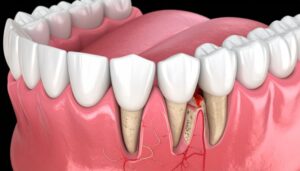
If your gums seem healthy, you might not give them much thought. They are simply the soft pink tissue that surrounds your teeth! However, they are worthy of serious consideration. Their health plays a key role in your oral and overall wellness. One issue that sometimes arises in the gums is known as periodontal pockets. What exactly are periodontal pockets, and how can you get rid of them? This blog post explains what you should know.
What Are Periodontal Pockets?
Healthy gums are securely attached to the teeth; there is a tight seal that protects the vulnerable tooth roots. Periodontal pockets, on the other hand, are a sign of gum disease. They are spaces or gaps that develop between your teeth and gums.
These pockets develop when plaque and bacteria collect along your gumline, leading to inflammation and infection. This infection sometimes causes your gums to pull away from your teeth, forming pockets where more bacteria can accumulate. The deeper these pockets become, the more severe the gum disease.
Signs You Have Periodontal Pockets
Periodontal pockets are not readily visible to the naked eye. Here are some signs that you might have them and accompanying gum disease:
- Your gums bleed easily when you brush or floss.
- Your gums appear red, swollen, or tender.
- You notice persistent bad breath or a bad taste in your mouth.
- Your teeth feel loose or shift in position.
- Your gums are receding, causing your teeth to appear longer.
- You see pus between your teeth and gums.
- Your bite feels different than usual.
Healing from Gum Disease and Closing Periodontal Pockets
If you notice any of the above-listed signs, you should visit your dentist as soon as possible. Your dental team can measure the depth of your periodontal pockets and recommend a treatment plan.
A thorough professional cleaning may remove plaque and tartar that you cannot reach with brushing and flossing alone. In more advanced cases, your dentist may suggest scaling and root planing, a deep cleaning procedure that smooths the root surfaces and helps your gums reattach to your teeth. Sometimes, antibiotics or special mouth rinses may help to reduce bacteria and inflammation. For severe cases where deep pockets do not respond to nonsurgical treatment, your dentist may recommend surgical procedures.
Gum disease can wreck your oral health! Therefore, you should watch out for the signs of periodontal pockets and seek timely care.
Meet the Practice
Dr. Vrajesh Shah is a prosthodontist (dentist who specializes in prosthetics) with more than 20 years of experience. He combines state-of-the-art technology and his extensive skill to provide comprehensive oral care, including gum disease treatment. If you are concerned about periodontal pockets and your gum health, Dr. Shah and our team are ready to advise you on your options. Contact Edison Prosthodontics at 732-943-1709.